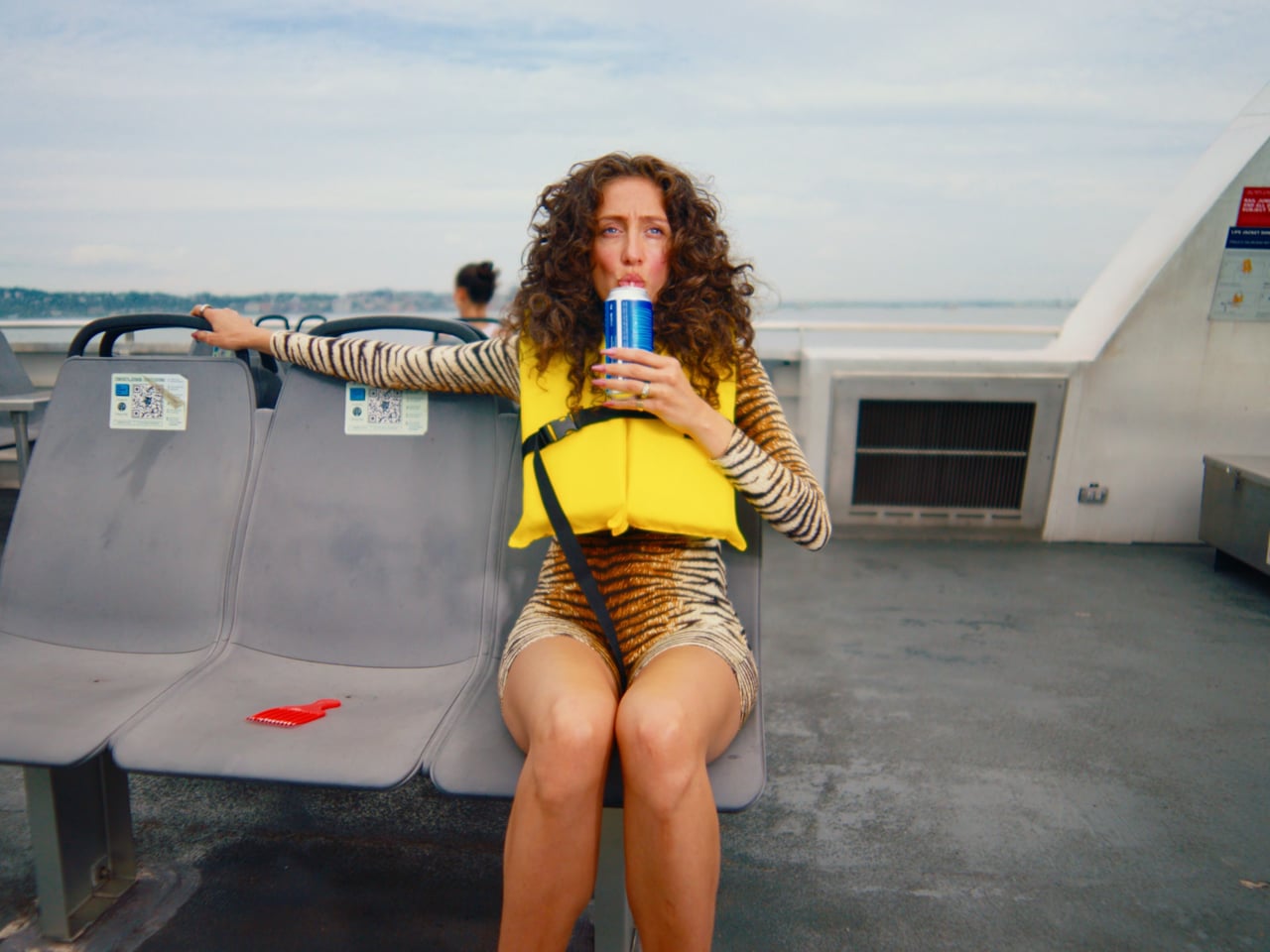

Heatwave
Your work draws out the deadpan humour of ordinary life – a wonky dinner table, a lost remote, a sticky New York afternoon – finding the strange little performances tucked inside routine moments. Are you consciously looking for the absurd, or does it tend to reveal itself once you start framing the scene?
I live in New York, so these everyday moments tend to reveal themselves naturally—I rarely have to go searching for them. I’m also deeply interested in people and love observing them. People are endlessly fascinating; everyone is a character in their own right, with unique qualities and nuances that set them apart from the person standing next to them. Myself included. I’m drawn to deadpan humour, but equally to the melancholy, longing, and quiet heaviness that people carry with them.

The Gilbertsons, The Unwrinkable Wrinkle
There’s a very precise sense of timing in your stills, almost as if the frame has landed on the funniest or most revealing second. How did you approach carrying that timing into film?
I’m very intentional in my approach to photography and filmmaking. Whether I’m shooting stills or motion, I plan everything meticulously, everything is staged.
The most revealing moment is essential to my work. Film invites a slower, more observant way of seeing, where static or gently unfolding shots allow us to experience a moment as we might in real life. What makes film so powerful is its ability to bring us closer to subjects we would not normally have access to, letting us sit with their presence and energy. Rather than rushing through fast cuts, I prefer to hold on these moments, allowing them to linger and speak for themselves.

From After Hours photography series
You began as a photo editor before becoming known as a photographer and now director. How has editing other people’s images shaped the way you construct your own?
When I was in college for photography, I thought that if I became a photo editor, I could make a living while staying connected to something I loved. Freelancing felt uncertain, and I knew I needed to support myself, pay off student loans, and build a stable future. My dream job was always New York Magazine.
During college, I interned at Billboard, Refinery29, and Saturday Night Live, hoping to get a step ahead. I’ve always been competitive in that way—if I was sitting still, I felt like I wasn’t doing enough.
After graduating, I worked at Cosmopolitan, and then I shot the New York Magazine “rat cover,” which ultimately led me into my dream role as a photo editor at New York Magazine.
In that role, I had the opportunity to pitch myself for projects I was interested in, and to hire photographers I had long admired, as well as friends whose work I believed in.
I realize I may be answering this in a more narrative way, but I felt it was important to share the full journey. I also think “photo editor” is a misleading title—you’re not editing images in Photoshop, but rather working with writers’ stories and pairing them with photographers in a way that strengthens both text and image. The process is about building a visual language that supports the narrative.
One of my favorite parts of the job has always been collaborating with photographers to push an image further than they initially imagined—to help them arrive at work they are proud of, often more than they expected at the start. I always want to produce work that feels aligned with their voice, which is exactly why I hired them in the first place.
I love that I’ve been both a photographer and an editor, because it allows me to understand both sides of the process. Having to consistently edit down selects for stories has also made me faster and more decisive in my own photographic work over time.

From After Hours photography series
Your work has a humorous undertone, but it never feels like it’s reaching for a joke. How do you keep comedy subtle rather than overplayed?
I don’t think all of my work carries a humorous undertone—After Hours, for example, is more rooted in a feeling of quiet heaviness. However, I do enjoy weaving subtle humour into other parts of my work, such as The Gilbertson’s shorts. I’m not interested in making jokes outright, as that can feel a bit forced or distasteful. For me, the strongest comedy is always understated, grounded, and relatable. It feels human. I would say I carry those traits myself, which is why they naturally find their way into my work.

From After Hours photography series
Heat Wave captures something very particular about New York: the sweaty intimacy, the agitation, the collective delirium of the city in summer. What was the first image or feeling that unlocked that film for you?
While working on my After Hours series, I decided I wanted to make a film that carried the same nocturnal moodiness. I’ve always been drawn to observing people, and Heat Wave was an attempt to bring the viewer closer to that experience. It’s rare that we’re able to observe someone we don’t know in such an intimate way. Much of my work is shaped by the feeling of my upbringing in upstate New York—the atmosphere, the people, and the environment that still feel familiar to me. The first image I knew I wanted was of a little boy gulping down a giant soda bottle. There is an image in my head of my cousin doing this at my grandma’s house when we were little.

From After Hours photography series
After Hours has this beautiful sense of emotional detachment – people alone together, or alone with their routines; the moments after something has happened or before anything begins. What drew you to those in-between states, and to making them feel so quietly beautiful?
This is actually the first time I’ve spoken about what this project is truly about. After Hours is a deeply personal series that I began to understand only a few frames into shooting. When I was working at New York Magazine, I was in the office five days a week with a long round-trip commute, which meant the only time I had to photograph anything personal was after work. Before this, I had never really photographed at night—it was something I was pushed into by circumstance.
I’ve always been drawn to character studies, and I started the series by asking both people I knew and strangers I found online to meet me at sunset. I would place them in a location, give them an outfit, and ask them to step into a character within my world. I would shoot two rolls of film before the sky went fully dark, often with them holding the same pose—an expression I didn’t fully understand at the time.
It wasn’t until I was on the subway home one night that something clicked. I looked around and saw everyone in a kind of autopilot state—tired, moving through the motions of getting from one place to the next. I noticed my own expression and body language mirrored it, and I realized I was doing the same thing. That became the key to understanding why I had been directing my subjects into these poses of fatigue, stillness, and detachment.
In many ways, the characters I was creating were simply projections of myself. Once I understood that, I was able to push the work further. The project is still ongoing, even though I’m no longer at the magazine. Those feelings haven’t gone away.

You’ve joined Riff Raff’s Nursery of Evil, their home for emerging directors. Given that you already have such a fully formed visual language, what kind of stories or worlds would you like to explore next?
I have a very short film I would love to create called Mary. The project is currently on hold until I secure funding. I wrote Mary without realising at the time that, much like After Hours, it was also about myself.
I would love to explore the world of fashion through my work, creating beautiful ads that don’t necessarily feel like ads. Fashion has the ability to build entire worlds, and to create shorts that exist somewhere between commercial and film.


Above stills from Summer Food film for New York Magazine